
“BMS calls UFBU’s Strike notice illegal
NOBW and NOBO signed the very same kind of notice for twenty-nine years”
Two documents landed on the Department of Financial Services’ desk within days of each other, and together they read like a case study in objecting to the UFBU strike, for two different reasons, without noticing the contradiction. The Bhartiya Mazdoor Sangh (BMS) went first with a letter, arguing that the coming bank strike is illegal because neither IBA nor UFBU is a registered trade union, and neither, therefore, had any business issuing a strike notice in the first place. NOBW and NOBO followed close behind with a circular of their own, choosing a rather different line. The strike, they said, is not so much illegal as politically motivated, badly timed, and something the country could do without. Between the two letters sits a detail neither one mentions: NOBW and NOBO spent twenty-nine years inside the very UFBU they are now helping to declare illegal, signing the same notices, settlements, and strikes they suddenly cannot seem to recognise.
“How UFBU stayed legitimate for twenty-nine years and suddenly turned illegal, for NOBO/NOBW & BMS, in the space of one letter is, as it happens, rather an interesting story and worth reading to the end.”
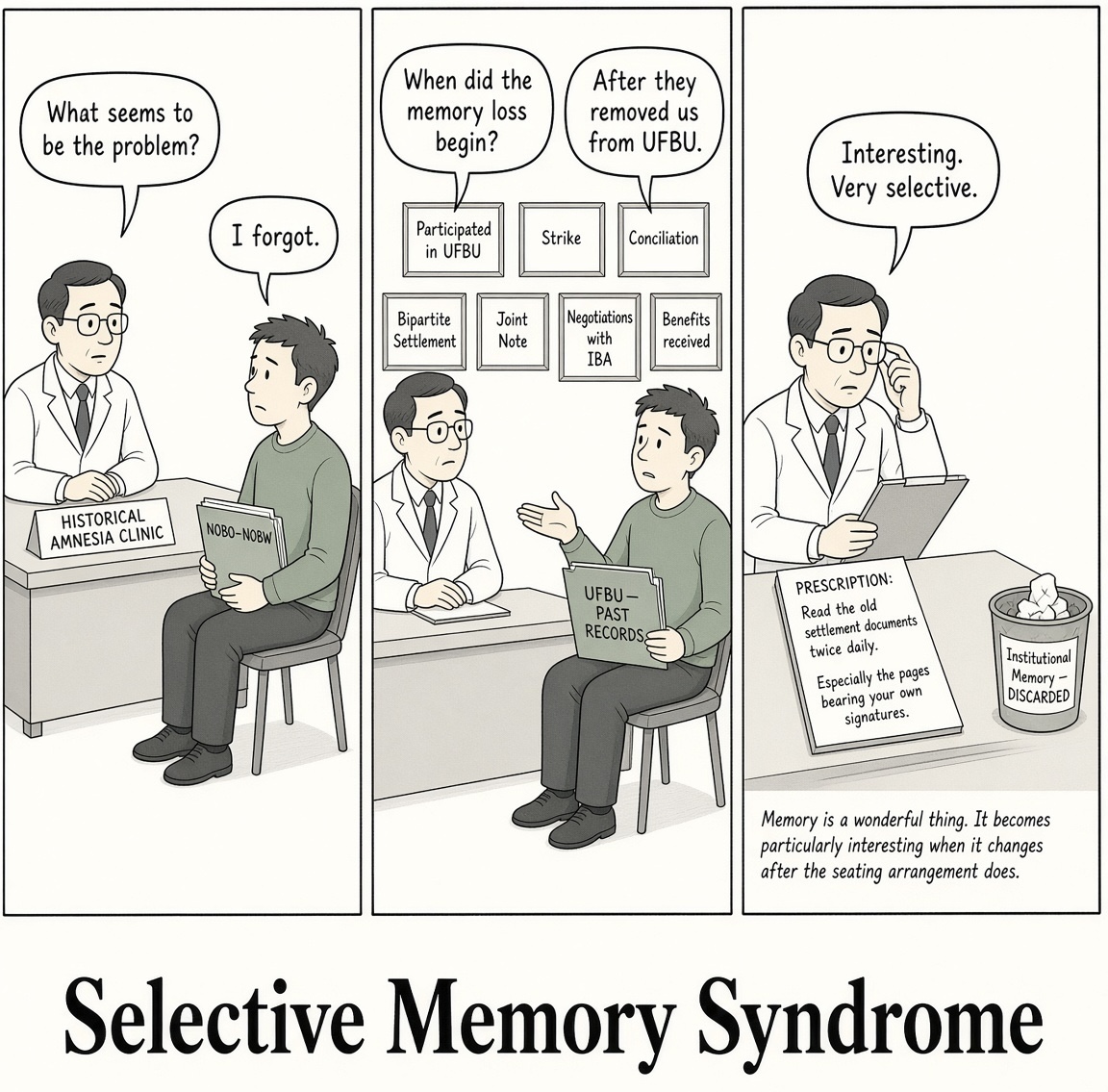
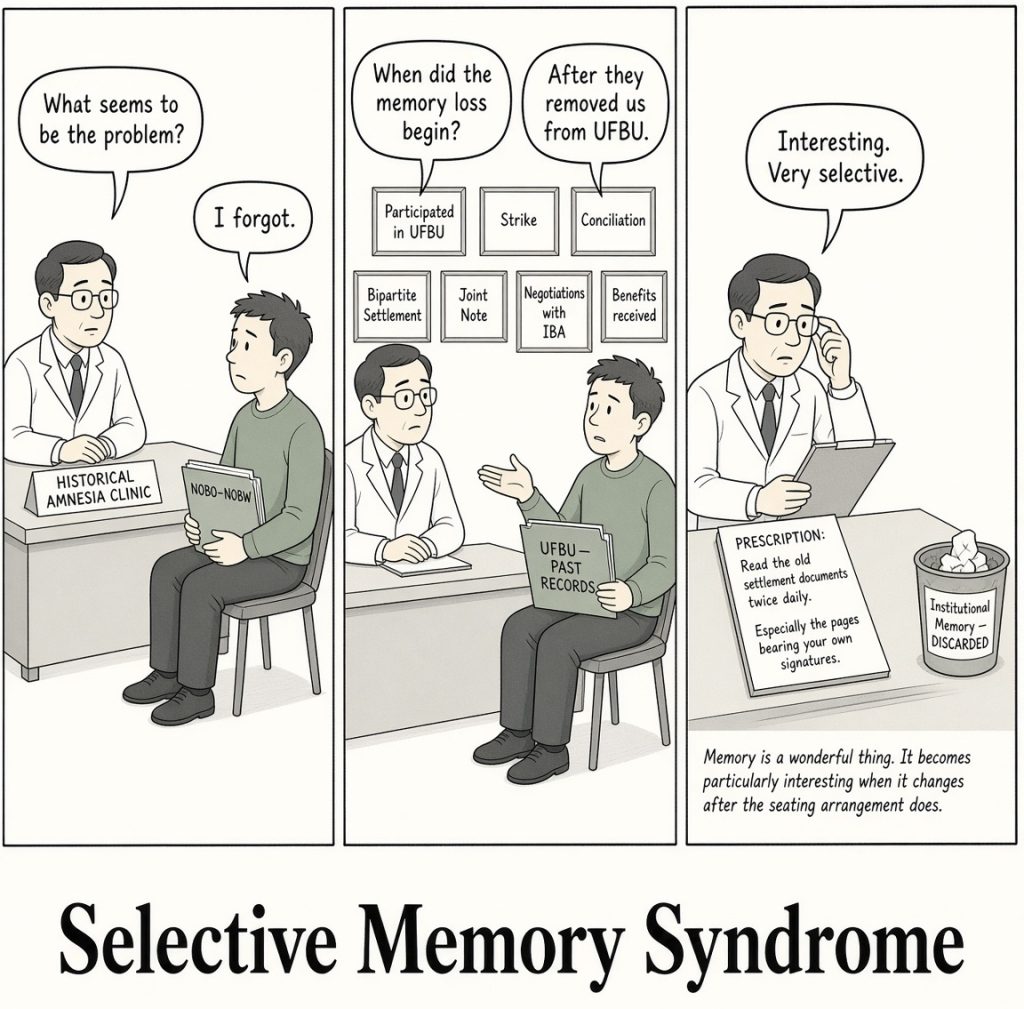
NOBW and NOBO have discovered, rather suddenly, that they are deeply worried about politics entering the banking movement. This is touching, coming from an organisation that has just handed its own strike-notice objections to a political party to fight on its behalf. Their letter of 8 September calls the planned strike on 11 September “politically motivated.” It does not explain how a demand that unions negotiated years ago, and the government simply refused to notify, becomes “political” only once NOBW and NOBO decide to call it so. Nor does it explain why an organisation that spent twenty-nine years signing the very documents it now calls illegal should suddenly discover the illegality only after walking out of the room. Some things are best described plainly: this is not principle, it is memory loss, and it arrived on a remarkably convenient schedule.
UFBU has been around for almost three decades, formed by nine unions, including NOBW and NOBO, who agreed they would win more together than apart. For most of that time, NOBW and NOBO were not bystanders. They signed strike notices jointly with everyone else. They sat at the table when demands were drawn up. They put their names on the same wage settlements that gave bank employees family pension and dearness allowance protection. They even struck work alongside the rest of UFBU as recently as this January, for the same five-day banking demand they now call political. They left UFBU only a few weeks ago, reportedly over an internal dispute. Nobody has yet explained how the very same UFBU that was legitimate enough to negotiate their benefits for twenty-nine years became illegitimate the week after they left it.
There is a simpler story here than constitutional law, and it has to do with numbers rather than principle. An organisation that isn’t growing has two choices: grow, or find someone bigger to make noise on its behalf. NOBW and NOBO appear to have picked the second option, and BMS was happy to oblige. BMS writing angry letters to the government on NOBW-NOBO’s behalf looks a great deal like support. Whether BMS is fighting for NOBW and NOBO, or simply fighting through them to make its own point, is a fair question worth asking. An umbrella held by someone else is still someone else’s umbrella; those standing under it should check whether it’s raining on them, or on their host.
Take the five-day banking demand itself. UFBU negotiated this issue for more than a decade and finally the IBA agreed and signed the Bipartite / Joint note. What has been missing since, is not negotiation, but a “notification” the government has simply not issued. NOBW and NOBO’s own account of meeting the Finance Minister and receiving “positive assurances” only confirms this: the file has been sitting untouched for years. So when NOBW and NOBO call the resulting strike “politically motivated,” they are, in a strange way, correct, except the politics belongs to the government that keeps postponing a promise it already made, not to the workers still waiting for it.
NOBW and NOBO call the strike political.
The only politics on display is the government’s four-year silence on five day banking.
As for the claim that UFBU itself is not a legal entity and cannot issue strike notices, this is the same argument being made by an organisation, BMS, that was not even present at the table for most of this history, dressed up as a legal opinion. NOBW and NOBO signing on to it is where the story turns genuinely funny: they are asking the government to declare illegal the very process they used, happily and repeatedly, for twenty-nine years, right up until the day they left it. If a structure was sound enough to deliver decades of settlements, strikes, and benefits, it does not become unsound the week, NOBO & NOBW walk out the door and start looking for reasons to blame UFBU. That is not a legal argument. That is a punchline dressed up in legal language, and bankers are unlikely to miss the joke.
None of this means NOBW and NOBO don’t genuinely want five-day banking, fair incentive pay, or better pensions. They probably do. The problem is simpler: an institution that was good enough to deliver decades of results for them cannot become suspect only after they’ve left it, and a demand cannot become “political” only once it’s inconvenient to support. If NOBW and NOBO are serious about resolving these issues rather than scoring points, the twenty-nine years of settlements they signed make a stronger case than the letter they’ve just written.
“If political motivation is really the test, ask who benefits from the silence. It is certainly not the bank employees, still waiting for five-day banking.