
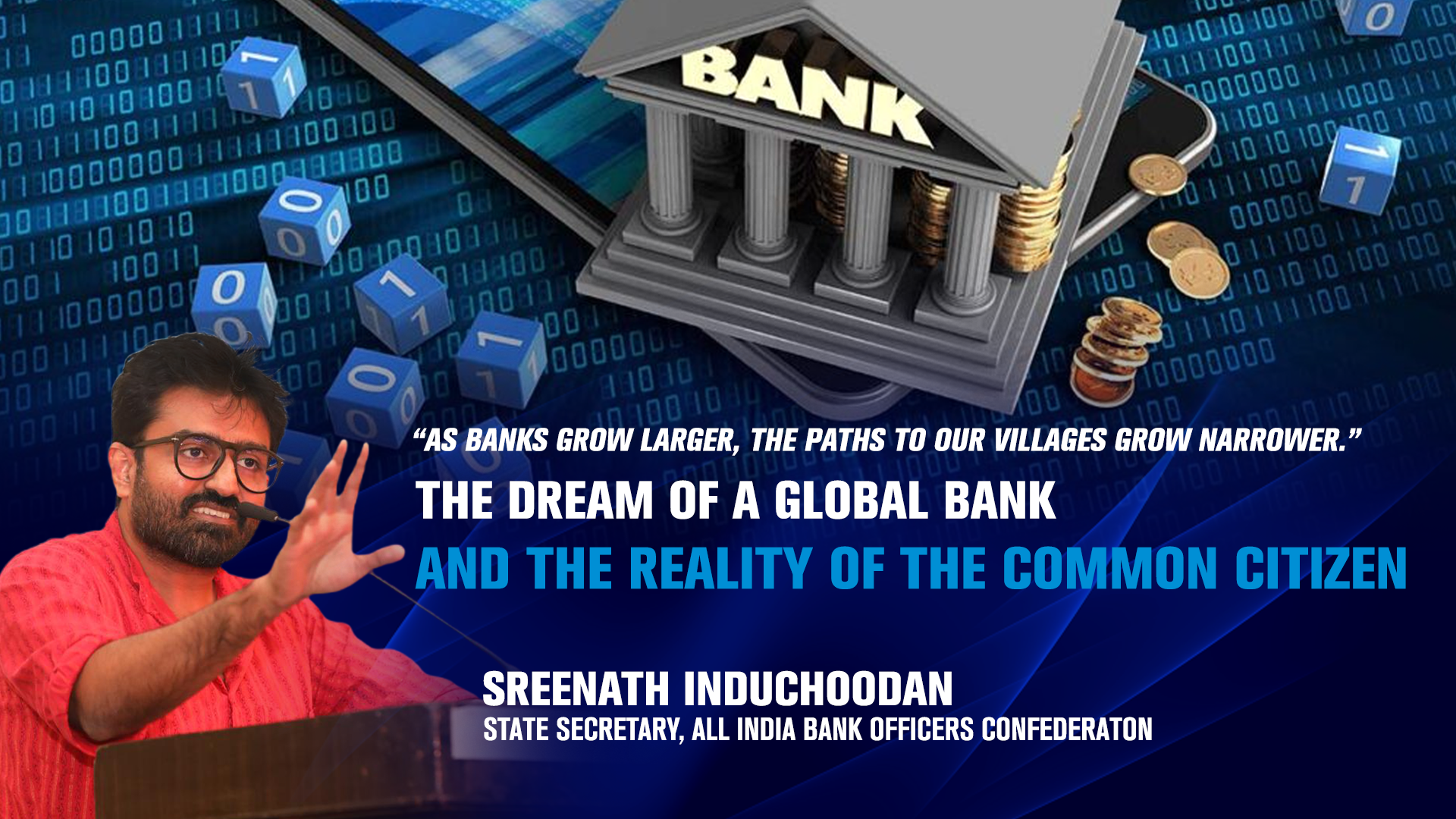
“As banks grow larger, the paths to our villages grow narrower”
Rumours are growing stronger about a renewed attempt to push forward another round of mergers among Public Sector Banks (PSBs). Reports suggest that the underlying aim is to position at least two Indian PSBs among the world’s top 20 banks. The idea of large-scale mergers and acquisitions in India’s public banking sector gained momentum after the merger of SBI’s associate banks with the State Bank of India in April 2017.
Later, in 2019, Bank of Baroda absorbed Vijaya Bank and Dena Bank. Just before the pandemic, another major consolidation took place, reducing the number of PSBs to twelve.
Since 2017, India has consolidated its public sector banks. Five SBI associates merged with SBI, and in 2019, ten nationalised banks became four larger entities. The government now aims to place at least two Indian PSBs among the world’s top 20 banks by 2047. However, this goal remains ambitious. Today, only SBI ranks 43rd and HDFC Bank 73rd in the global top 100. Supporters claim larger banks can lend more easily to big firms and reduce consortium hassles. Critics argue mergers alone do not ensure efficiency, inclusion, or better customer service.
At the PSB Manthan 2025 conference, held in Delhi in September 2025, the concept of “Viksit Bharat”(Developed India) was highlighted. Officials indeed spoke of making PSBs “globally competitive” champions of the nation’s development. But they also emphasised that growth should be organic and autonomous, not just the result of more mergers. In fact, government messaging at the conclave highlighted “organic growth and operational autonomy” for banks to achieve scale. (Oddly, just days later the government opened PSB leadership to private-sector bankers, a move that may further change the character of these state-owned banks.)
The vision of Viksit Bharat belongs to every Indian. But the critical question is whether this vision includes the upliftment of ordinary and marginalised citizens—ensuring a model of All-Inclusive Development.
Decades ago, the government nationalised public sector banks to promote inclusive growth and ensure credit reached farmers, workers, small businesses, and the poor—not just big industry. Yet, today’s data reveal persistent vulnerability. The latest consumption survey (HCES 2022–23) estimates that 26.4% of Indians still live below the poverty line. Rural households remain especially cash-strapped. According to NABARD’s All-India Financial Inclusion Survey (2021–22), the average rural household earns ₹12,698 per month and spends ₹11,262, leaving almost nothing to save. Over 52% of rural families have outstanding debt, and only 44% of agricultural households possess a Kisan Credit Card, the main source of formal farm credit. These figures reveal a stark reality: despite economic optimism, millions of Indian families still live hand-to-mouth, depending on public sector banks for their basic financial survival.
Poverty (Household Consumption): ~27.4% of rural and 23.7% of urban Indians are below the poverty line – about 26.4% overall
Rural Income & Spending (NAFIS 2021–22): Average monthly income ~₹12,700 vs. expenditure ~₹11,262 – hardly enough left over.
Debt & Credit: 52.0% of rural households have outstanding debtOnly 44% of farm households have a Kisan Credit Card (i.e. ~56% have no KCC), forcing many to rely on costly informal loans.
https://www.nabard.org/PressReleases-article.aspx?id=25&cid=554&EID=91#:~:text=,22
Meanwhile, there are worrying signs of PSBs pulling back. A recent RTI report revealed that public sector banks closed or merged nearly 4,837 branches in the past two years. The loss of branches in small towns and villages risks creating a financial vacuum. Private banks or informal moneylenders may quickly fill this gap, reviving the very exclusion that nationalisation once sought to end. At the same time, while private banks are expanding their hiring, the public sector’s workforce is shrinking. The number of PSB employees dropped from 8.57 lakh in 2016–17 to 7.7 lakh in 2021–22, even as the overall banking workforce increased.
Performance Metrics: Supporters of consolidation point to improved bank health. Indeed, PSBs have delivered record profits and far better asset quality in recent years. In FY2024–25 the 12 largest PSBs earned a combined net profit of about ₹1.78 lakh crore – a 26% jump over the previous year and gross NPAs fell to 2.58% by March 2025 (from over 9% in 2021). Their capital adequacy is strong (CRAR ~15.4% as of Sep 2024 well above RBI’s 11.5% norm). These are signs of financial stability. PSBs also still fund a large share of priority-sector credit: as of FY2025 they accounted for about 36% of total priority-sector lending. Nonetheless, these macro metrics say little about who gets the credit. If the emphasis shifts too heavily toward big corporate lending and global benchmarking, the rural and small-borrower segments may suffer.
For over five decades, public sector banks have played a vital role in ensuring India’s financial stability and inclusive growth. Policies that prioritise large corporate lending at the cost of rural and common borrowers could undermine the nation’s socioeconomic progress.
Let us recall the Gandhian Talisman:
“Recall the face of the poorest and the weakest person you have seen, and ask yourself if the step you contemplate is going to be of any use to them.”
As India advances in digital finance, AI-driven banking, and unified lending, millions still rely on public sector banks. For them, these banks remain the only path to financial dignity—a true lifeline for rural India, not just a branch or building.